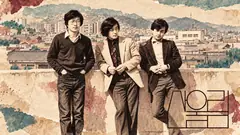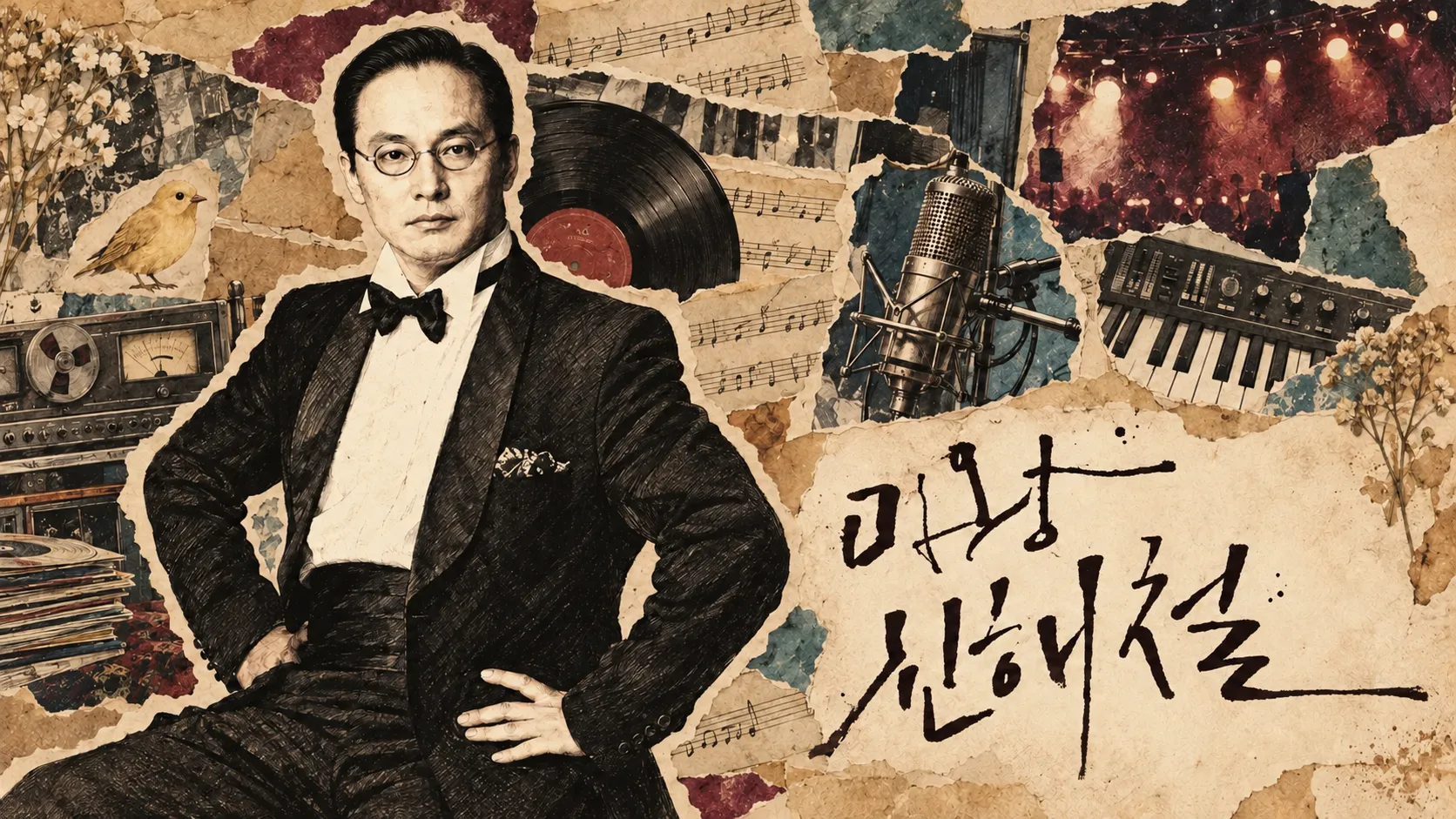
From the opening of “To You” to Yali the chick, late-night radio and “Dream of a Freshwater Eel”: the places where Shin Hae-cheol’s songs and words met everyday life.
Article
“To You” (“그대에게”) excites a crowd before the singing even starts. Its recognisable introduction brings a face to mind. At the 1988 MBC College Song Festival, that face belonged to Shin Hae-cheol, vocalist of Muhangwedo. Before he became known for speaking his mind on radio and discussion programmes, he appeared before us with this song. 1
Muhangwedo — To You, 1988 MBC College Song FestivalCalling that performance “the birth of the Demon King”—his later nickname—can make everything that followed seem too inevitable. He still had records to make and kinds of music to try. Knowing the ending does not mean we need to give the first performance every meaning at once. He was a twenty-year-old band singer who would leave the stage and consider what to do next.
A one-man band on Myself
After Muhangwedo, Shin became a solo singer with songs including “Don’t Look So Sad” (“슬픈 표정 하지 말아요”) and “Jazz Cafe.” He was performing under his own name rather than a band’s. That period may feel unfamiliar to listeners who first loved his later rock music. He could not always work exactly as he wanted from the start. 2
In an interview during his lifetime, Shin Hae-cheol said that the thing he wanted most during his debut was to record his own songs in a recording studio. The music on his first solo album was far from the heavy metal he originally wanted to do, but the fact that he could record it felt even more important at that time. In another interview, he explained that he started making music with the intention of being in a band, and that if circumstances did not work out, he would first try to find an opportunity by doing music. 34
The young man so eager to enter a studio took on an entire band’s work on his second solo album, Myself, in 1991. He handled lyrics, composition, arrangement, instruments and production as well as singing. Rather than assemble musicians to play together, he used MIDI to programme and layer instrumental parts in a one-man-band approach. 12
Writing a song and deciding which instrument enters when, with what sound, are different tasks. On Myself, Shin did not stop after creating the melody and lyrics and stepping up to a microphone. He built the backing music too. The album’s title also fits its working method.
“Jazz Cafe” and “A Letter to Myself” deserve more than a passing mention as hits before N.EX.T. They come from a time when someone who wanted a band was making its sound by himself. Listening to the singer also draws attention to the layers behind his voice.
Shin Hae-cheol — Jazz Cafe, live on EBS Space GonggamA later performance of the solo-era song with a different arrangement, distinct from the 1991 original recording.A letter addressed to himself
“A Letter to Myself” invites the listener to look inward. Following others’ expectations and losing sight of your own wishes is not confined to youth. At twenty, a career choice may be the concern; later, it may be whether to continue on the path already chosen. There is still room to put your own name in the title. 8
Shin Hae-cheol — A Letter to Myself, from MyselfAudio from his second solo album, provided by Danal Entertainment.Writing the song does not mean he subsequently lived without doubt. A letter to yourself need not mean you already have all the answers. It can ask whether this is how you want to live, record a present belief and wait to be opened again. The song offers questions listeners can take into their own lives.
N.EX.T sings about the commute
Shin formed N.EX.T in 1992. “City People” (“도시인”), on their debut album Home, follows people hurrying through work and daily routines, ending one day only to face another. Nothing momentous needs to happen for the song to make that life feel uneasy. 25
Where “To You” offers the energy to run forward, “City People” questions the life spent running. Where are we going while working so hard? Why feel lonely among other people? Those questions do not end with the working day. Enjoying the voice becomes mixed with recognising something of our own lives.
Treating N.EX.T as a manual of answers to social problems would miss part of the pleasure. There are rhythms to move to and guitars to turn up. Thought need not displace enjoyment: one moment you can nod to the beat, and another can bring your commute to mind.
N.EX.T — City People, from HomeThe individual track provided by the N.EX.T Topic channel.If you give a name to a chick
The central character in the band’s 1994 “Fly, Chick” (“날아라 병아리”) is a small chick named Yali. A child meets it, cares for it and eventually experiences its death. Losing Yali becomes part of the child’s first understanding of death. 6
A song announced as a meditation on life and death might feel heavy. This one begins with a chick: small, yellow and easy to imagine cupped in a child’s hands. Following the story makes us care what happens to Yali. Its loss becomes a farewell recognisable to anyone who has named and cared for another living creature.
Shin Hae-cheol — Fly, Chick, live on EBS Space GonggamShin’s later live performance, distinct from N.EX.T’s 1994 studio recording.There is no need to manufacture a hidden side of Shin here. The singer of “City People” is also the person saying goodbye to Yali. An adult coming home from work can still remember a childhood pet. A listener drawn to rough vocals may fall quiet at this song. Both feelings could exist on a N.EX.T record.
A voice to talk with at night
Some people remember Shin somewhere other than a concert hall: in their room, listening to the radio. On FM Music City, Ghost Station and Ghost Nation, he played songs and talked with listeners. Where a song told a story for a few minutes, radio allowed his voice to continue between tracks. 7
An excerpt included in MBC’s 2024 retrospective preserves his suggestion that, if you have recognised how hard things are for your father, you might give him a hug. A short clip cannot supply the entire context, but the action is concrete: go home and hug him. The voice offers something possible now rather than a grand answer to life. 8
Listeners cannot all have responded alike. They would have agreed with some things and disagreed with others. Still, liking a singer’s songs and waiting to hear what he will say are different relationships. Waiting for the next track can become waiting for the next conversation. That helps explain why some remember him first as a DJ.
In reality, radio was not a comfortable position for Shin Hae-cheol. He said that he loved being a DJ as much as music, but that he felt distressed when his intentions were lost and his words were transformed in the process of what he said on air being translated into articles. There was both the joy of talking to people and the burden of having the story go beyond one's will. 3
Calling someone a good speaker does not show everything speaking costs them. Listeners spent a night with a familiar voice; the broadcaster might then have to watch how his words appeared in the next day’s articles. Knowing the difficulty he described makes a single memorable quotation feel inadequate as an account of the whole person.
A song addressed to a boy
This is a useful moment to hear N.EX.T’s “From the Sun to the Boy” (“해에게서 소년에게”), from the 1997 album Lazenca (A Space Rock Opera). Even its title is an address from one figure to another. Remembering Shin answering radio listeners can make the singing feel closer. 9
N.EX.T — Lazenca, Save Us + From the Sun to the Boy, 1997 SBS Gayo DaejeonTwo songs performed in sequence; “From the Sun to the Boy” comes second.“To You” can make us want to jump with a crowd; “Fly, Chick” may bring back a forgotten name. “From the Sun to the Boy” can offer words we once wished someone had said to us. The singer is the same, but the setting and the need differ. His music resists being reduced to a single character.
Its listeners cannot remain boys forever. They finish school, begin work and eventually worry about someone younger. A song once heard as advice to themselves may become something they want to share with another person. The song remains; the listener changes. Older music keeps finding a use in daily life.
An invitation to spend everyday life together
“Invitation to Daily Life” (“일상으로의 초대”) brings the wish for companionship closer to home. It makes room for uneventful time: walks, tea and thinking of someone. No grand stage or major resolution is needed to hear this side of Shin’s voice. 11
Shin Hae-cheol — Invitation to Daily Life (Radio Mix), official music videoThis is 1theK's official distribution video and Radio Mix version.Sharing your daily life is concrete. It includes more than the occasions when you dress well: ordinary habits and stretches with nothing to say belong too. Beside the other songs, this offers another way to remember Shin. Alongside his forceful public performances is a song making room for one person.
Making a living while making music
When you talk about things like this, it's easy to think that Shin Hae-cheol was always confident and would have done what he wanted to do until the end. But musicians also need money and time to make their next album. Shin Hae-cheol said he tended to spend the money he earned through music on his next album and make a living as a radio DJ. He also left an explanation that the gap in work became longer as production costs became difficult to obtain. 3
That account sits close to his memory of the solo debut. At first he was grateful simply for the opportunity to record; later he still had to find the conditions for making the next album. Fame and the ability to keep making the music he wanted were different problems. What felt like a long gap to listeners could also be a search for a way to resume work.
The recordings are therefore difficult to treat as inevitable. Moving from one to the next takes us a few clicks. Between them, he had to assemble a band, record and earn a living. A name familiar from the introduction to “To You” did not automatically make the next release possible.
Playing the final selection again
“Dream of a Freshwater Eel” (“민물장어의 꿈”) acquired the painful association of being played at Shin’s funeral. He had named it during his lifetime as the song he wanted for that occasion. That history matters, but it need not explain the entire work. The person singing it while alive and those hearing it then also had their own experiences with it. 10
Shin Hae-cheol — Dream of a Freshwater Eel, from Welcome To The Real WorldAn officially distributed recording on YouTube. This upload’s album metadata refers to a 2015 compilation, not the song’s original release year.We encountered Shin’s music in different settings. “To You” belonged at gatherings; “Fly, Chick” might be the choice after a loss. A solitary, thoughtful night could recall something he said on the radio. Perhaps the songs and words remain together because both met listeners inside their lives.
A large nickname can keep someone in memory, but sometimes it helps to return to smaller things: a young man wanting to enter a studio, a chick with a name, a suggestion to hug a father. Then the introduction to “To You” again. Heard in that order, the face behind the nickname “Demon King” becomes a little different.
Sources and reporting notes
- MBC University Song Festival · Muhangwedo 〈To You〉
- Yonhap News · Shin Hae-cheol, the “Demon King” who helped lead the popularization of rock music
- Ten Asia · Direct interview with Shin Hae-cheol on July 9, 2014
- Channel Yes · 2007 Shin Hae-cheol Interview ②
- Yonhap News · On-site coverage of the 10th anniversary tribute performance in 2024
- EBS · Episode 308 Shin Hae-cheol 〈Fly, Chick〉
- MBC · Our Brother, Shin Hae-cheol official program introduction
- MBC News Desk · Remembering Shin Hae-cheol, the man nicknamed the “Demon King”
- Genie · N.EX.T 〈From the Sun to the Boy〉 Song Information
- Shin Hae-cheol Topic · Freshwater Eel’s Dream Distribution Sound Source
- 1theK · Invitation to Daily Life Radio Mix Official Music Video
- maniadb · Shin Hae-cheol’s 2nd album Myself album credit
- Shin Hae-cheol — Jazz Cafe, EBS Space Gonggam live performance
- Shin Hae-cheol — A Letter to Myself, included in 《Myself》
- N.EX.T — City People, 《Home》 sound source
- N.EX.T — Lazenca, Save Us + From the Sun to the Boy, 1997 SBS Gayo Daejeon
The linked sources document the reporting. Personal recollections reflect the speakers’ memories, and comments on the music are editorial interpretation.
Machine-translated from Korean. Read the original.