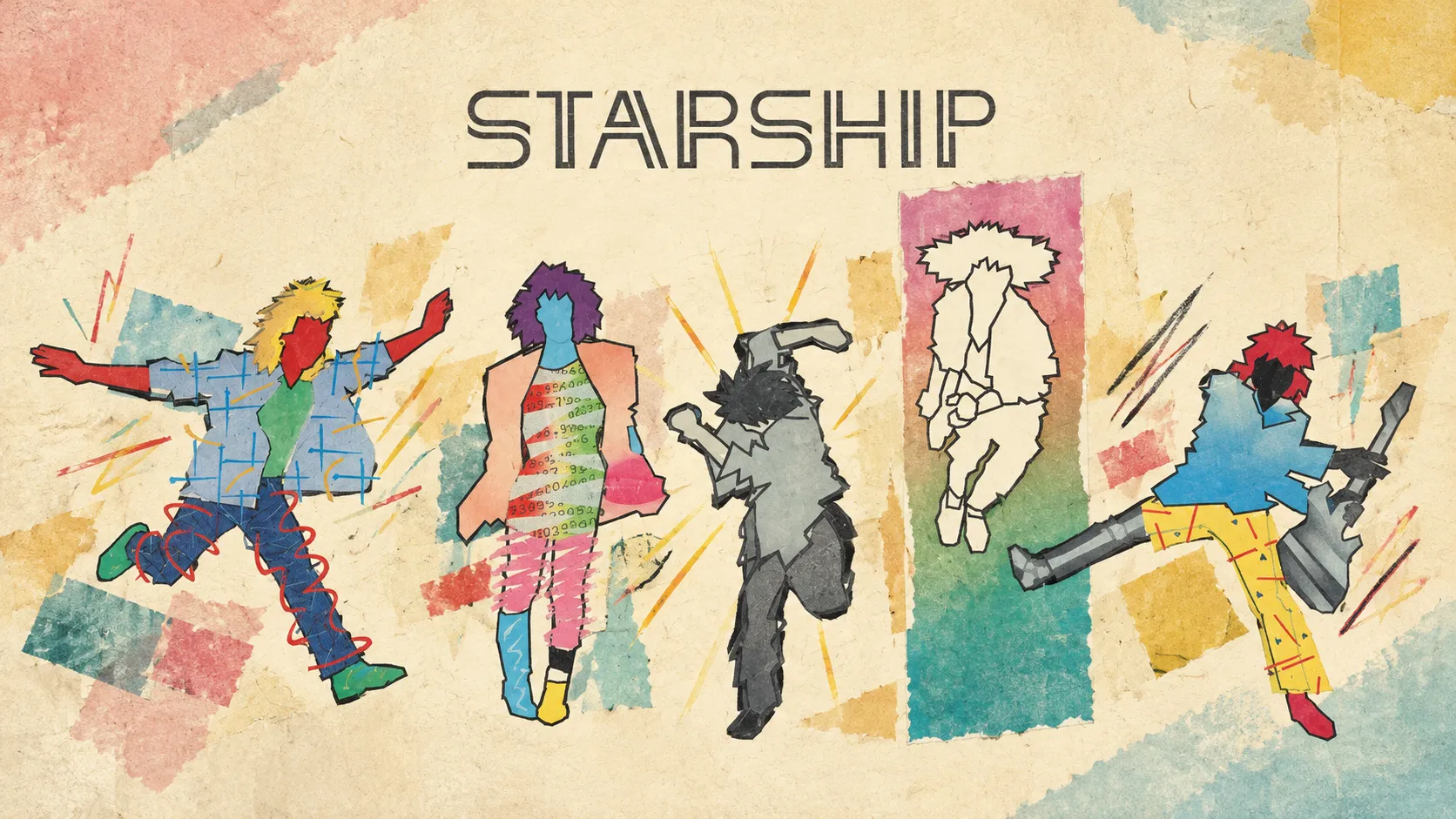
A “worst pop song” label need not end your enjoyment. Six songs trace the changing bands and voices, from Jefferson Airplane’s Grace Slick to Marty Balin and Mickey Thomas.
Article
They say it’s the ‘worst pop song’, but I like it
Liking Starship’s “We Built This City” can sometimes feel like a taste you have to defend. The song carries a famous “worst pop song” label. Yet its buoyant rhythm and the chorus sung by Mickey Thomas and Grace Slick may make that judgment hard to share. You can read why people dislike it and still be pleased when it comes on.
The label has a source. Blender named it the worst song of all time in 2004. GQ later invoked that reputation in the title of an oral history with people who made the record. One publication’s choice was repeated until it became almost part of the song’s description. But a list cannot decide what the song means to someone who enjoys it.1
Equally, reaching No. 1 in the United States does not settle every criticism. The song topped the Billboard Hot 100 in November 1985 and later became an object of ridicule. Commercial success and musical judgment are different things. To understand that gap, it helps to step back from the synthesisers. Before Starship there was “Jefferson,” and before that, other voices in another era.2
We Built This CityA song from the 1985 album “Knee Deep in the Hoopla.” RHINO official music video.San Francisco's airplane, Jefferson Airplane
Formed in San Francisco in 1965, Jefferson Airplane deserves more than a footnote as Starship’s former name. Marty Balin, Paul Kantner, Jorma Kaukonen and Jack Casady were among its distinctive musicians. By the late 1960s the band had become a leading name in psychedelic rock and the counterculture, part of an era of searching for new sounds onstage and on record.34
Grace Slick was not there from the beginning. She joined Jefferson Airplane in 1966 after playing with the Great Society. “Somebody to Love” and “White Rabbit,” from 1967’s Surrealistic Pillow, brought her voice to a wide audience. Someone later familiar from Starship had been singing in a very different setting nearly twenty years earlier.5
“White Rabbit” does not keep circling back to an exuberant chorus. Tension begins low and builds as the voice becomes increasingly commanding. In a song bringing Alice’s world together with the sensibility of the 1960s, Slick has the power to transform the atmosphere. Listeners who began with this voice might feel the later contrast with “We Built This City” sharply. Noticing a difference and preferring one song are still separate matters.56
White RabbitOfficial audio of Jefferson Airplane’s 1967 recording, sung by Grace Slick.The move to Jefferson Starship and “Miracles”
The Airplane did not simply change its sign to Starship one day. As Jefferson Airplane’s activities fragmented in the early 1970s, several projects developed, including Hot Tuna. Jefferson Starship grew from one of those paths. Some musicians stayed or returned, but the old lineup did not move intact into a new name.3
The name Jefferson Starship first appeared on Paul Kantner’s 1970 album Blows Against the Empire. The band itself took shape in 1974. Dragon Fly featured Kantner, Slick, David Freiberg and Craig Chaquico, among others; Marty Balin’s subsequent arrival changed the combination again.7
You can hear that change in “Miracles,” from 1975’s Red Octopus, written and sung by Balin. Its opening keyboards and violin and its flowing melody move in a different direction from “White Rabbit.” Music bearing the Jefferson name was not confined to tense, unfamiliar sounds. A love song helped bring major success, and the album topped the US Billboard album chart.89
That is what makes this history interesting. The songs between the experimental rock of the 1960s and the pop of the 1980s vary too much to describe the journey as one abrupt turn. As members arrived and different voices took the lead, the band kept making different music.
MiraclesOfficial sound source of the song included in 《Red Octopus》, 1975. Composed and lead vocals by Marty Balin.Mickey Thomas arrives, and “Jane” follows
The lead voice changed again in 1979. After Balin and Slick left, Mickey Thomas joined from Elvin Bishop’s band. It was more complicated than fitting a new singer into an established group. Thomas later recalled initially wondering whether his background in blues, soul and rhythm and blues would fit these musicians.10
In a 2013 interview, he remembered several meetings and sessions playing together. Drummer Aynsley Dunbar’s arrival also brought a harder rock character. Thomas felt that the musicians’ differing backgrounds helped create the new style—a part of his story easily missed when he is remembered only for the later pop hits.10
“Jane,” on 1979’s Freedom at Point Zero, came from that period. This is not the voice that sang “Miracles.” Thomas soars above the firmer backing of the band. For someone who first recognised him through Starship’s pop records, the song reveals another period of his singing.11
JaneOfficial sound source of the song included in 《Freedom at Point Zero》 in 1979. The voice of Mickey Thomas during the Jefferson Starship era.Dropping “Jefferson” and pursuing pop hits
In the early 1980s, Slick returned to the band. Now Slick and Thomas' voices were on the same stage. However, differences between founder Kantner and the other members grew over the direction of the music. In the mid-1980s, when he left and the conflict over the name was resolved, the remaining members made a new album as Starship, without ‘Jefferson’.712
Thomas later recalled feeling that this was already a different band from the early Jefferson Starship, and that he had considered dropping “Jefferson” himself. A new name could not erase the past, but it could be read as a request to hear the new music on its own terms. The decision also reflected the wishes of musicians who wanted to keep the band going.12
The result was 1985’s Knee Deep in the Hoopla, which embraced pop through collaborations with outside songwriters. Bernie Taupin, Elton John’s longtime lyricist, was among the credited writers of “We Built This City.” Rather than relying only on material written within the group, they welcomed contributions from other writers and producers.13
The song invokes rock music, yet its production is gleaming 1980s pop. That gap could trouble listeners attached to the earlier band. But the bright synthesisers and the chorus driven by two voices are also what make it recognisable. The same quality criticised as “too pop” can be someone else’s reason for loving it.213
The next number one under the new name is 〈Sara〉
If you lump Starship's pop into one song, 〈We Built This City〉, there is a song that is missed. This is 〈Sara〉 from the same album. This song, released as a single in late 1985, ranked first on the Billboard Hot 100 on March 15, 1986. The year the album was released and the year the song topped the charts are different.14
This time Thomas takes the lead in a ballad addressed to someone leaving. The voice still opens up in the chorus, but the mood differs from the exuberance of “We Built This City.” The same singer on the same album can create a different emotional atmosphere.
Thomas later distinguished the restraint and seriousness of “Sara” from his other pop hits. Starship’s new audience need not have liked just one kind of song. For listeners who remember the band through its ballads, the turning point may be this voice calling a name rather than the rousing song about a city.14
SaraThis song was released on an album in 1985 and reached #1 on the US single chart in 1986. RHINO official music video.Two voices in a film’s love song
In 1987, “Nothing’s Gonna Stop Us Now” came out with the film Mannequin. This song was written by Albert Hammond and Diane Warren. The names of the film and the two composers are listed together in the 1988 Academy Award Best Original Song nomination record. This does not mean that Starship won this award.15
Slick and Thomas trade lines before opening up together in the chorus. Slick’s earlier identity did not have to disappear for the new pop music to exist. The singer remembered for the force and strangeness of her Jefferson Airplane performances is now singing a love duet. The same voice has a different role in another era’s song.
The song also spent four weeks at No. 1 on the UK’s Official Singles Chart, reaching audiences beyond the band’s American success alongside the film. Its synthesisers, expansive chorus and cinematic associations may seem excessive to one listener and exactly right to another.16
Nothing’s Gonna Stop Us NowA song connected to the 1987 movie “Mannequin.” RHINO official music video.Returning to Starship after hearing Jefferson
Jefferson Starship and Starship remain distinct names when researching the bands. Kantner revived Jefferson Starship in 1992, while Thomas continued under “Starship featuring Mickey Thomas”; each has its own official site. Treating either lineup as the same people in an unbroken line from the 1960s confuses their histories.717
Where one listener hears the loss of Jefferson Airplane in “We Built This City,” another hears their first encounter with Starship. Different starting points bring different expectations. Discovering earlier music does not require giving up the song you first loved.
Return to “We Built This City” after Slick’s “White Rabbit,” Balin’s “Miracles” and Thomas’s “Jane,” and the people behind the chorus become clearer. Some left the Airplane, others joined the Starship, and musicians sharing a name wanted different kinds of music. When the two voices come together again, knowing that history adds something to the pleasure of a song loved despite its “worst” label.
Sources and reporting notes
- GQ · 2016 oral history with the record’s creators; source for Blender’s 2004 ranking
- Rhino · Release of We Built This City · No. 1 in the US in November 1985
- Jefferson Airplane Official · 1965 formation and various branches of activity
- Rock & Roll Hall of Fame · Status of Jefferson Airplane and 1996 induction
- Bethel Woods Center for the Arts · Jefferson Airplane and Slick’s arrival in 1966
- Jefferson Airplane · White Rabbit official audio
- Official history of Jefferson Starship · Name in 1970 · Band in 1974 · Restart in 1992
- Jefferson Starship Official · 50 Years Ago Restart and Red Octopus
- Member interview published by Jefferson Starship · Miracles and several vocalists
- Mickey Thomas Direct Interview · 2013-07-04 Joining and Music Change
- Jefferson Starship · Jane official audio
- Goldmine · The names and choices of 1985, as recalled by Mickey Thomas
- Rhino · 1985 Knee Deep in the Hoopla and its two singles
- Rhino · Sara's 1985 single release · No. 1 on March 15, 1986
- Academy · 1988 Theme Song Nominee Mannequin
- Official Charts · Nothing’s Gonna Stop Us Now UK Single Chart
- Starship featuring Mickey Thomas official site
- RHINO · Official music channel
- JeffersonAirplneVEVO · Official Music Channel
- Jefferson Starship · Official Music Channel
The linked sources document the reporting. Personal recollections reflect the speakers’ memories, and comments on the music are editorial interpretation.
Machine-translated from Korean. Read the original.