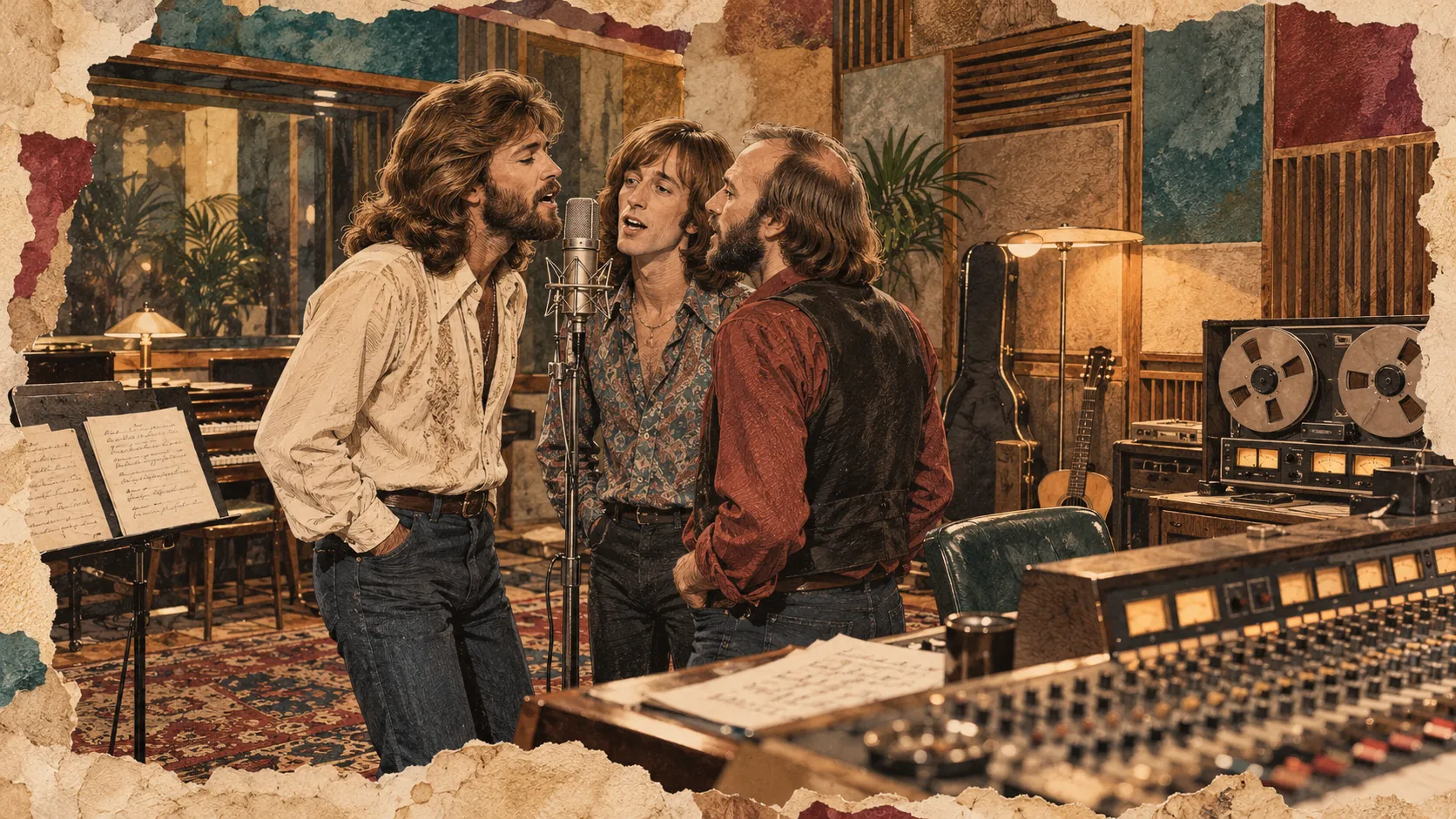
From Beatles comparisons to a Miami bridge rhythm and a studio experiment with falsetto: the story of three brothers finding new uses for their voices.
Article
In 1967, a strange rumor followed the Bee Gees’ “New York Mining Disaster 1941”: the three brothers’ song was supposedly the Beatles recording under another name. Some listeners even read Bee Gees as an abbreviation of “Beatles Group.” The Beatles loomed so large that an unfamiliar group’s recording could summon those four familiar faces first. 1
Today the Bee Gees may first suggest high falsetto, white suits, and disco rhythms. This song instead describes a man trapped in a mine, showing a photograph and asking about his wife outside. The guitar is restrained and the voices close together. Anyone familiar only with “Stayin’ Alive” might hesitate. Listeners then hesitated for the opposite reason: could those voices really be someone other than the Beatles?
Bee Gees — New York Mining Disaster 19411967 video from official channelBefore the Beatles comparisons
Calling them Beatles imitators makes for a simple origin story. The Beatles did greatly influence the brothers, but that description alone leaves out their earlier years playing resorts and bars in Australia. Barry remembered singing soaked by rain leaking through a roof. The brothers learned to sing together on small stages like those, rather than in a room plotting to copy someone else’s success. 2
When their Australian release “Spicks and Specks” became popular, the family was already aboard a ship returning to Britain. They had left seeking a bigger opportunity and learned of the success afterward. A few weeks after their arrival, Robert Stigwood called, having heard the tape they sent. He wanted to meet them. He was then the business partner of Beatles manager Brian Epstein, adding a business connection to the musical comparisons. 3
Stigwood admired the brothers’ songwriting and harmonies. He heard something special in their combined voices. The Bee Gees began recording in Britain as a band including drummer Colin Petersen and guitarist Vince Melouney, making their first international album. Even while listeners heard the Beatles’ influence, the man signing them heard possibilities in the brothers’ own songs. 3
Songwriters imagining another singer’s voice
“To Love Somebody,” on the same album, reveals another possibility. At Stigwood’s request, Barry and Robin wrote it with Otis Redding in mind. 4 The brothers being compared to the Beatles were imagining an American soul singer. Their later interest in rhythm and blues did not come from nowhere.
Where “New York Mining Disaster 1941” draws a listener into a small story, “To Love Somebody” builds feeling through repetition. Heard together, the songs resist a description as merely Beatles-like. The brothers could write with another voice in mind and sing the result themselves, with their own harmonies still recognizable.
Bee Gees — To Love Somebody1967 album track · Official audioA rhythm on the drive through Miami
A distinctive sound did not guarantee the next success. In the mid-1970s, the brothers were reshaping their music with producer Arif Mardin. Eric Clapton recommended Miami, where they recorded Main Course at Criteria Studios. Synthesizers and sharply defined rhythms entered music previously wrapped in sweeping strings. 5
Their daily route to the studio crossed a bridge. The regular sound of the car passing over it stayed with them and helped inspire “Jive Talkin’,” initially called “Drive Talkin’.” 6 Before a declaration of musical direction came the sound of an everyday journey. The clipped guitar and moving bass in the introduction suggest why that rhythm caught their attention.
Bee Gees — Jive Talkin’official music videoA higher voice at the end of a song
During “Nights on Broadway,” from the same album, Mardin asked for a high ad-lib near the end. Barry tried singing in falsetto. His later recollection was modest: a producer wanted to make a song more interesting, and a singer tried something at the microphone. 7
The famous high voice does not run through the whole song. High ad-libs emerge over lower, firm vocals and change the effect. It lets us hear a transition taking place. Falsetto, now considered a defining Bee Gees sound, was entering as a new way to enliven the end of a song.
Bee Gees — Nights on BroadwayFrom Main Course · Official audioFalsetto was not invented that day. What matters is how Barry began using it more actively in his songs. The brothers changed rhythms and arrangements and found another use for a familiar voice. Rather than deliberately becoming the opposite of the Beatles, they expanded what they could do as their collaborators and surroundings changed.
When the man in the movie started walking
Stigwood asked the Bee Gees to write songs for a film about New York disco culture. They worked in a French studio, and their songs became central to Saturday Night Fever. Film and album helped each other succeed. 8 Once John Travolta’s walk down the street was paired with “Stayin’ Alive,” the scene became difficult to separate from the group’s image.
Behind the drums supporting that walk lay work rarely visible on stage. Recording participants explained that a short section of the drum performance on “Night Fever” was made into a tape loop for the basic rhythm of “Stayin’ Alive.” A passage now easily looped on a computer required joining physical tape. 9 Its unwavering motion owes something to the people working with tape as well as the musicians.
Bee Gees — Stayin’ Aliveofficial music videoAn enormous success can make one period seem like an artist’s whole identity. For the Bee Gees, that identity was disco. Their official site notes that they were not originally known as a disco group; that image strengthened after Saturday Night Fever. 10 First labeled Beatles-like and later the face of disco, the songs between those descriptions are easily overlooked.
Three voices at one microphone
Engineer Michel Marie recalled preparing separate microphones and headphones for the brothers, only to be surprised when they wanted one microphone. They watched one another and sang together. Other engineers also described their voices blending better together than when recorded separately. 11 Assembling three vocal parts afterward was different from capturing singers listening to one another from the start.
Return to “New York Mining Disaster 1941” and there is no famous high falsetto or Miami groove yet. Still, the three voices already work together. Listeners who mistook them for the Beatles remembered the sound under another name. Yet something the Bee Gees preserved through later changes was already there: one voice moving forward while the other two supported it, the sound of people who had sung together for years.
Sources and reporting notes
- Rolling Stone — When Robin Gibb Reigned
- Bee Gees Official — Humble Beginnings
- Bee Gees Official — The Very Very Beginning
- Bee Gees Official — Bee Gees 1st
- Bee Gees Official — Main Course
- Bee Gees Official — Behind the Track: Jive Talkin’
- CNN — Larry King Weekend, Bee Gees interview (2002)
- Library of Congress — Saturday Night Fever album commentary
- Sound on Sound — Classic Tracks: Bee Gees, Stayin’ Alive
- Bee Gees Official — Blue-Eyed Soul Music
- Bee Gees Official — The Process
The linked sources document the reporting. Personal recollections reflect the speakers’ memories, and comments on the music are editorial interpretation.
Machine-translated from Korean. Read the original.