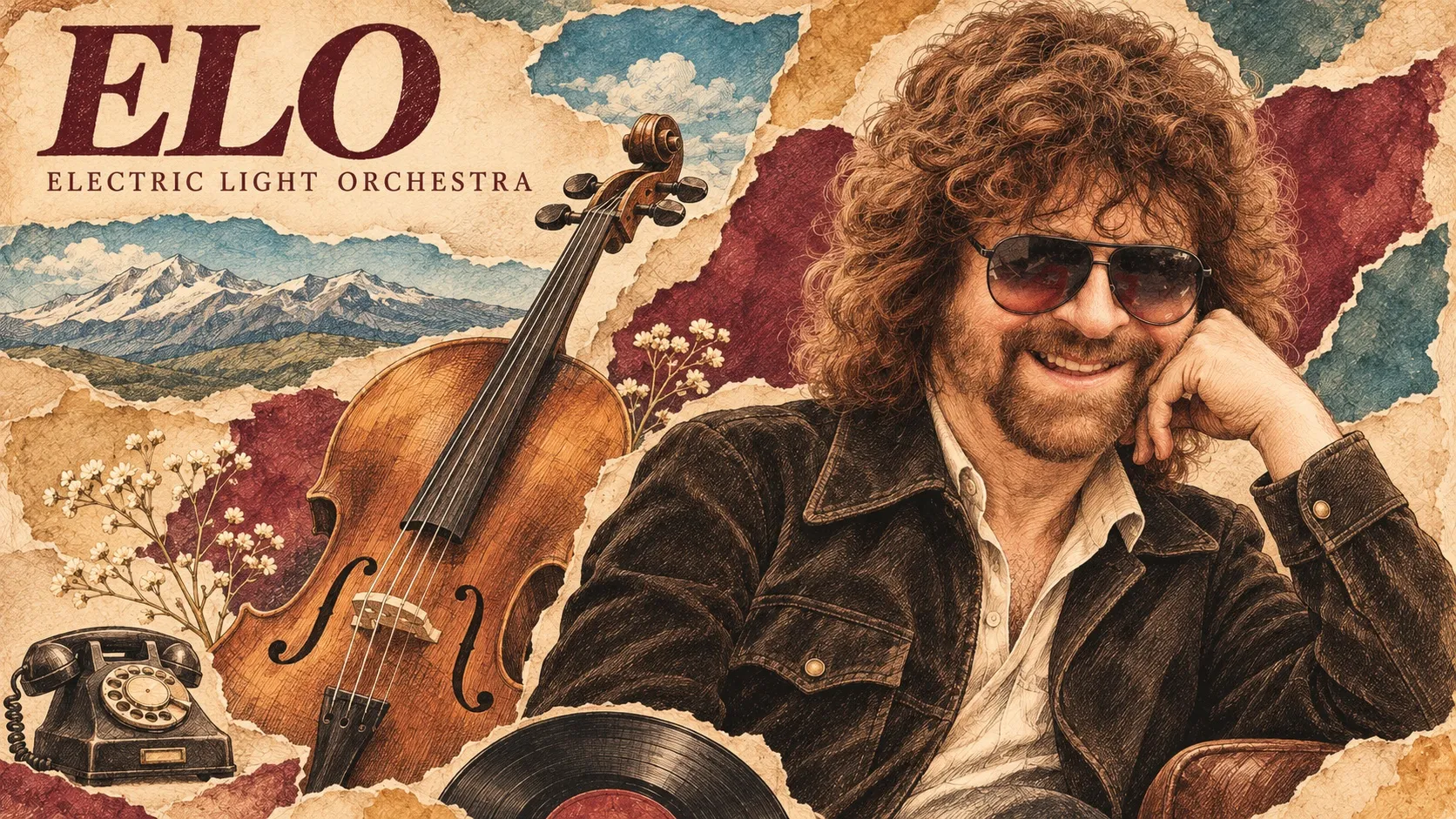
From “Mr. Blue Sky” in a Swiss chalet to a telephone tone made on a synthesizer and a final request to turn the LP over: stories from the making of eight songs by Jeff Lynne and ELO.
Article
Waiting for clear weather in a Swiss chalet
After several grey days, a clear sky can make opening a window feel inviting. ELO’s “Mr. Blue Sky” may bring such a morning to mind. Jeff Lynne recalled an actual change of weather at the Swiss chalet where he stayed to write his next album: blue sky emerging after mist and cloud became the song’s starting point.1
The clear morning inspired the song, but its lyrics did not come quickly. Lynne told CBS that refining them took several weeks. The weather changed in a day; finishing the words took much longer.7
Electric Light Orchestra — Mr. Blue SkyFrom Out of the Blue, 1977 · Official videoRoy Wood arrived with a cello
ELO stands for Electric Light Orchestra, and the name reflects its starting idea: bringing a rock band together with strings. The Rock & Roll Hall of Fame later highlighted that combination as a defining feature. Once cellos and violins joined guitars and drums, the band had to find ways to record that sound and reproduce it onstage.8
The early “10538 Overture” includes Roy Wood’s cello. Lynne recalled Wood learning to play it for the track, trying another instrument in a guitar-like role. Onstage, time was also needed for Wood to switch to instruments including oboe and bassoon.3
The debut album containing “10538 Overture” appeared in 1971, six years before “Mr. Blue Sky” on Out of the Blue. Hearing the two together offers a comparison of the guitar-and-string arrangements ELO had been exploring since its beginnings.6
Those strings caused problems in performance. Lynne remembered feedback from cello microphones at early shows. Reproducing a large studio string arrangement with two cellos and a violin was another difficulty. The recorded sound was not easy to bring intact to the stage.4
Electric Light Orchestra — 10538 OvertureFrom the debut album, 1971 · Audio from the official channelChuck Berry’s song invited Beethoven in
In 1973, ELO recorded “Roll Over Beethoven,” originally released by Chuck Berry in 1956. They placed the familiar motif from Beethoven’s Fifth Symphony at the beginning. Music by the composer named in the title leads into Berry’s rock and roll. The album and single versions differ in length, so recordings under the same title can have different running times.9
Electric Light Orchestra — Roll Over BeethovenELO’s 1973 version · Audio provided by Epic/LegacyThe melody his father wanted to hear
Lynne’s father complained that his son’s songs lacked a memorable tune. Lynne recalled writing “Can’t Get It Out of My Head” in response. Rather than explaining the arrangements or the number of instruments, he wrote a song with a melody his father might remember.3
Eldorado, the album containing the song, expanded the strings too. Lynne remembered using an orchestra of about 40 musicians for the first time on “Eldorado Overture.” A band that had begun with a few cellos now recorded with a large ensemble. In the same interview, he also said he preferred a good tune to a long guitar solo.2
Electric Light Orchestra — Can't Get It Out of My HeadFrom Eldorado, 1974 · Official audioAn unanswered call: “Telephone Line”
For anyone who remembers ELO through “Mr. Blue Sky,” “Telephone Line” offers another expression. Someone calls, but nobody answers. The person wanting to speak is here; the hoped-for reply is elsewhere. Lynne explained that he worked out the pitches of an American telephone ringing tone and recreated it on a Moog synthesizer. Rather than simply inserting an actual call recording, he constructed the waiting scene in the studio.4
While the ringing tone repeats in a receiver, the caller has not yet given up. Perhaps one more ring will bring an answer. The waiting in “Telephone Line” resembles that moment. Before the song unfolds, the telephone tone establishes someone waiting for a reply.
Electric Light Orchestra — Telephone LineFrom A New World Record, 1976 · Official video“Turn to Stone” opens a double album
Out of the Blue (1977) opens with “Turn to Stone.” Lynne described it as built from simple chords and as a particular favourite. It shares the album with “Mr. Blue Sky” and opens the double LP.26
A title search now takes a listener directly to a song. On an LP, its side and position were part of listening too. Follow the album from “Turn to Stone” and “Mr. Blue Sky” arrives much later. Its ending even includes an instruction for moving on to the next side.
Electric Light Orchestra — Turn to StoneFrom Out of the Blue, 1977 · Official audioThe last request in “Mr. Blue Sky”
Side three contains the grouping “Concerto for a Rainy Day,” ending with “Mr. Blue Sky.” The electronically processed voice at the end of the album version does not say the song’s title. It asks the listener to turn the record over. Lynne clarified the misunderstanding in his CBS interview. The third side of a double LP had finished; the last side was waiting.7
Two bars of drums for “Don’t Bring Me Down”
Moving to Discovery in 1979 brings “Don’t Bring Me Down.” Its production story draws attention to a short piece of tape before any large orchestra. Lynne described taking roughly two bars of drums from another song and repeating them. It was not as straightforward as copying a section on a computer: the tape had to run as a loop and be recorded again.56
Lynne added bass, piano and guitars over the repeating drums. In The Quietus, he described the loop and the instruments he played. Whereas Eldorado had involved a large orchestra, this track was built by repeating a short drum recording and adding instruments above it.4
Electric Light Orchestra — Don't Bring Me DownFrom Discovery, 1979 · Official videoJeff Lynne returned to the boy he had been
Alone in the Universe, released as Jeff Lynne’s ELO in 2015, includes “When I Was a Boy.” Lynne explained that it reflected his own childhood feelings about music, while also fitting another child who wanted to play guitar. After many years, he returned in song to the boy who had wanted to begin making music.10
Jeff Lynne's ELO — When I Was a BoyFrom Alone in the Universe, 2015 · Official videoSources and reporting notes
- NPO Radio 2 — 제프 린이 들려준 Mr. Blue Sky의 탄생
- Rock Cellar — Ken Sharp의 제프 린 인터뷰 (2016)
- Classic Rock — Mark Blake의 제프 린 인터뷰 (2012 인터뷰·2025 재게재)
- The Quietus — Simon Price의 제프 린 인터뷰 (2015)
- Mix — Matt Hurwitz의 제프 린 녹음 인터뷰 (2012)
- Jeff Lynne’s ELO — 공식 음반 목록
- CBS Sunday Morning — David Pogue의 제프 린 확장 인터뷰 (2019·배포 녹취)
- Rock & Roll Hall of Fame — ELO 소개
- Wikipedia — Roll Over Beethoven, 원곡·ELO 버전과 길이 구분
- Guitar World — 제프 린이 설명한 ELO의 재출발과 Alone in the Universe
The linked sources document the reporting. Personal recollections reflect the speakers’ memories, and comments on the music are editorial interpretation.
Machine-translated from Korean. Read the original.